Meta Ads for businesses already making sales. Written rules, an open dashboard and everything in your name.
I run your account myself: structure, creatives, cuts and scaling, with the rules published on this page. I execute; I don't send you a PDF of recommendations. If your store and your tracking already work, I don't touch them.
The pixel, the ad account and the website are set up in your name from day one.
Three-month minimum commitment, said here and not in the third meeting.
THE PROOF, TOLD ONCE
What I can prove today. Without stretching it.
My own stores, one client case, one experiment with my own money, and a gap that's still a gap. Every figure appears once on this site, with its source and with what it doesn't prove.
OWN STORES · MY MONEY · DATES ON THE PANELS: FEBRUARY 2024
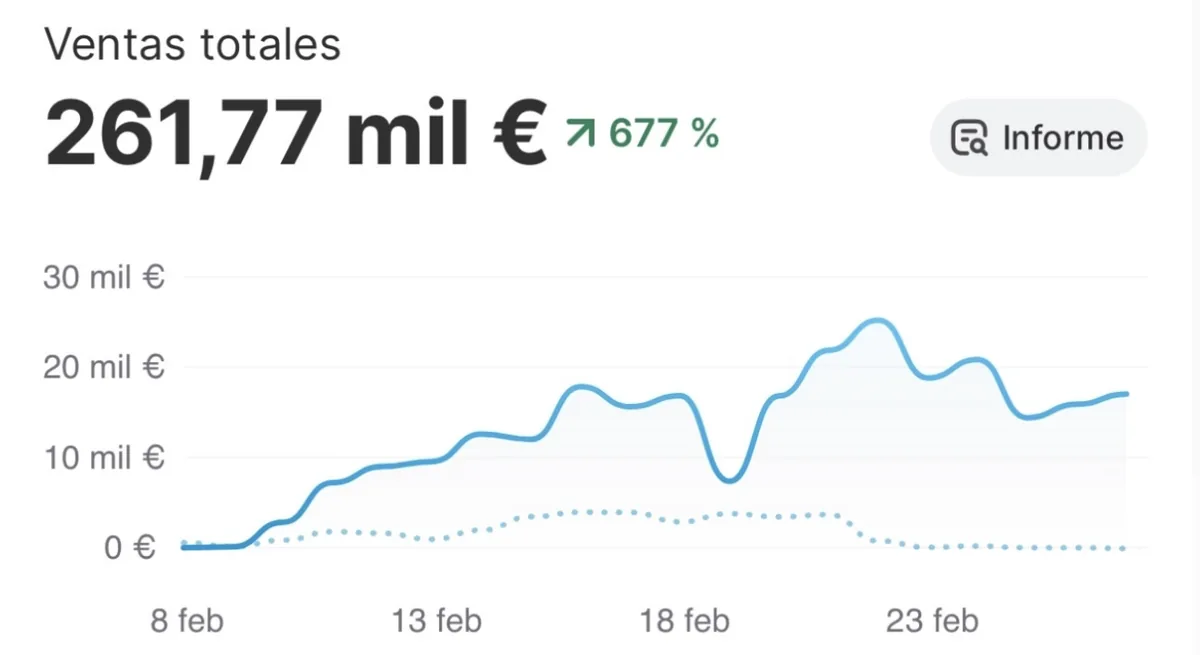
From zero to €261,770 in a month, with net profit on display.
Before running client accounts I built and scaled my own. This is the best one: launched on the 8th of February, €261,770 in sales that same month. And the panels below aren't ROAS: they subtract product cost, fees and ad spend. That's net.
Launch-month sales
€261,770 (8–26 Feb)
Mid-month cut
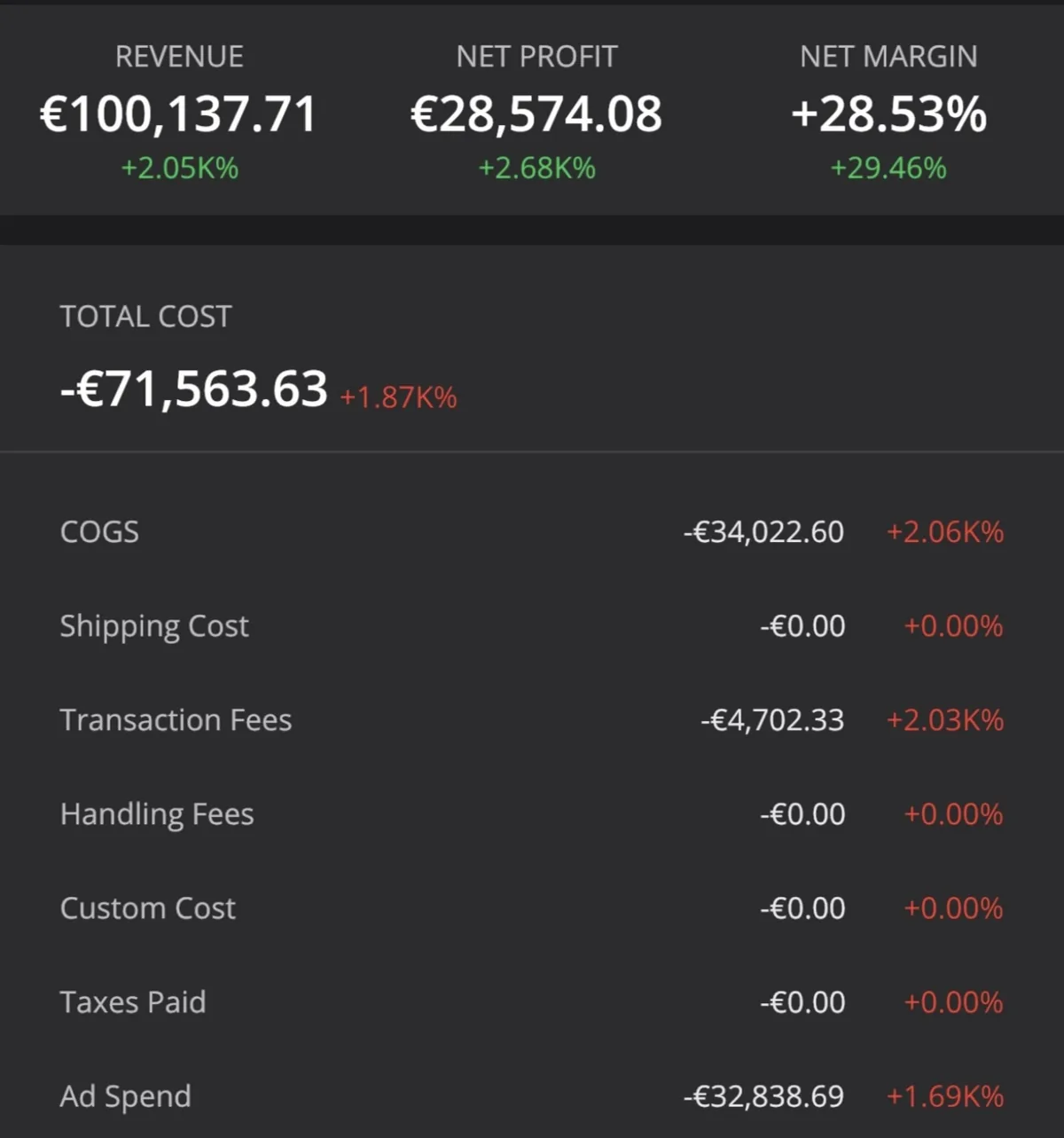
€100,137 revenue · €28,574 net · 28.5% margin
Best day
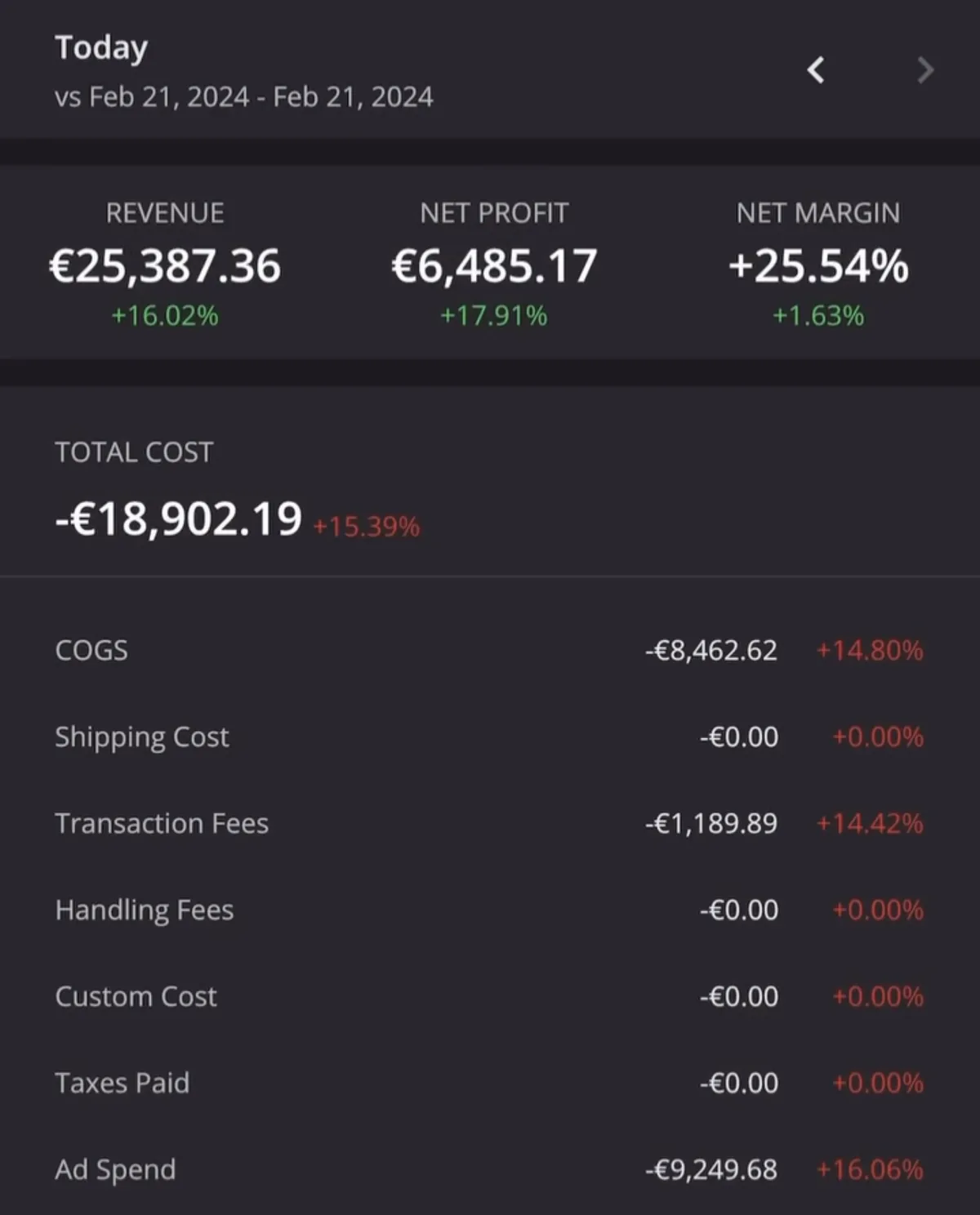
€25,387 sold · €6,485 net
Daily ad spend
from €1,900 to €9,250 in two weeks
Daily net margins
between 22% and 37%
Another store, in pounds
£51,713 in 30 days · £11,900 peak day with 244 orders
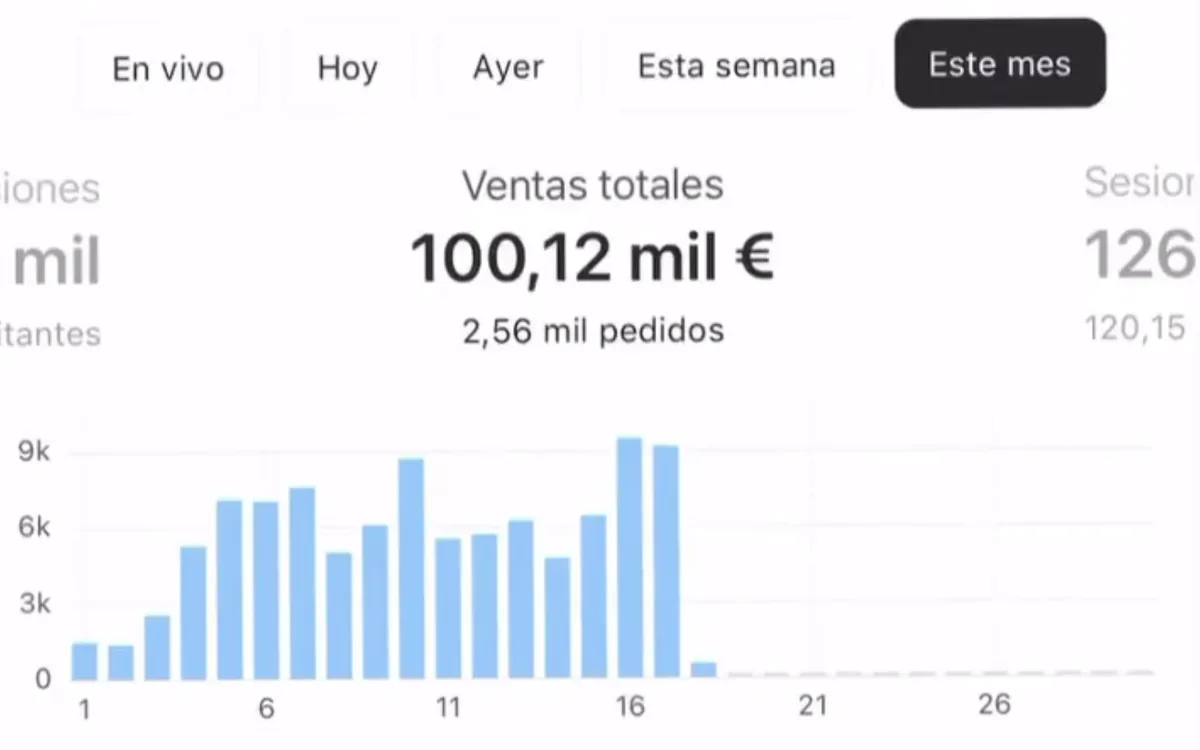
Shopify · the launch month: €261.77k (8–26 Feb)The mid-month cut, in NET terms: €100,137 revenue · €28,574 profit · with COGS, fees and €32,838 of ad spend subtractedOne day at the peak (21 Feb 2024): €25,387 sold · €6,485 net · €9,249 of ad spend that dayThe same cut seen from Shopify: €100.12k and 2,560 orders — two different panels, the same figure
Look at the spend: it went from €1,900 to €9,250 a day in two weeks with net margin holding between 22% and 37%. Scaling isn't raising the budget: it's raising it without the margin giving way.
What this doesn't prove: these were fast-launch stores, not a client's mature account — they show I can operate volume and heavy spend with my own money, not what will happen in your business. The growth percentages in the captures compare against near-zero days: they look impressive and mean nothing, so I don't use them.
Screenshots from the time, from Shopify and the profit dashboard, with COGS, fees and ad spend inside. The stores are closed now and can't be audited today — which is why I show you the captures instead of asking you to take my word. The GBP store's panel carries no date, and I'm telling you that too.
THE CASE · CLIENT ACCOUNT · UNITED KINGDOM · 14 MAY – 12 JUN 2026
$545, 46 purchases, ROAS 5.47. It's a small account, and I'm telling you before you think it.
A fashion store in the United Kingdom. If you're putting $3,000 a month into ads, that $545 is under a week of your spend: this case doesn't prove I've run your volume. It proves how the method behaves when the money belongs to a client.
Look at the distribution: of the 46 purchases, 45 landed in the last seven days. Over the first three weeks the campaign spent about $65 and brought one sale. That's the whole method right there: almost all the money went in when the signal appeared, not before.
What this is not: an average across my clients or a forecast for your account. The ROAS doesn't deduct product, shipping or fees — it isn't profit — and these are Meta dashboard figures, not audited by any third party.
Source: Meta Ads Manager, client account. I don't have their written permission to name them, so I don't. The day I do, the name goes here.
EXPERIMENT · THE CHECKBOX THAT SHOWS UP IN NO REPORT
Same audience, same budget: CPM of $4–15 on automatic placements, $29–52 restricted to Facebook and Instagram.
My own account, changing only the placements. I publish the ranges and not an 'X times more expensive': the multiple depends on which ends you compare, and this site doesn't round upwards.
It doesn't prove that restricting placements is always a mistake, nor that the gap would be the same in your account: it proves a setting has to be checked before it's accepted as good. If your agency restricts placements out of habit, look at its CPM.
THE GAP
What I can't show you yet.
Volume of my own I have operated, and it's right above. What I still don't have is a publishable CLIENT case with $3,000 a month sustained over a quarter: the difference matters, because operating your money and operating mine are not the same thing, and I won't dress one up as the other. When it exists, it goes here with its screenshot and its permission. If you need that proof to decide, it's a reasonable demand: ask me for it in the diagnostic.
How it gets decided where your money goes. In writing, so you can hold me to it.
The rules are set before anything is switched on. That way, at every weekly review you can check for yourself whether the decision follows the criteria or I'm making it up. It's the difference between delegating and signing an act of faith.
Rule 1 — The cut
Every test gets decided at €40–50 of spend: 0 or 1 conversions, out; 3 or more, a candidate for scaling. The moment to kill an ad is fixed before switching it on, not once you've spent three weeks defending your own idea.
Rule 2 — Scaling
When there's a signal, the budget rises 20% every three days. Never in one jump: a big leap resets the campaign's learning and sends you back to the start, paying more for it.
Rule 3 — The hierarchy
The number in charge is cost per purchase against your margin. CTR above 2% and CPC below €0.15 are cold-start references from my accounts in Spain — they're for smelling a problem early — not cut-off criteria: the case above ran at $0.32 CPC and was profitable, because its cost per purchase fitted inside its margin. If a reference threshold ever clashes with the CPA, the CPA wins. Every time.
The hole
What it sounds like when it's happening to you
The safeguard
Spend without a rule
'I'll give it one more day, it might pick up'
The cut is written before launch. There's no debate at two in the morning.
Broken tracking
'Meta says twelve sales and my platform says seven'
Pixel and Conversions API verified event by event, and the dashboard reconciled against real sales. When they don't match, I tell you why, not the number that flatters me.
The invisible setting
'The report is green, but every month I reach fewer people'
Settings audited against cost, not against habit. The placements experiment above came out of exactly this.
WHO OWNS WHAT
Everything is set up in your name. Including the day we stop.
The ad account and the Business Manager are yours. They're opened in your name, or I use the ones you already have, and I come in with partner access. Never the other way round: I don't put your business inside an account of mine.
The pixel and the Conversions API live in your account. The event history and the audiences built up over months are the real asset, and when the pixel belongs to the agency, that asset leaves with the agency.
The domain, the website and the code are yours. The domain is registered in your name and on your card; the store is opened with your email; if it's a hand-built site, I hand over the code.
The creatives are yours, with the original files, not just the published ad.
Your customers' data stays in your systems. I don't take a copy and I don't use it for anything else.
I work through delegated access from your own dashboards, not with your passwords. When we finish, I remove my access and leave you a handover document: where everything lives, who administers it and what gets paid each month.
If we stop tomorrow, you keep the store, the domain, the account, the pixel with its history, the creatives and your customer list. The only thing you lose is me.
THE PRICES, WITH THE SUMS DONE
What it costs, what it doesn't include and the sum other websites leave you to do yourself.
Managed Meta Ads
$2,000 – 3,500 / month
3-month minimum
The store or site that receives the traffic
$4,000 – 7,000
One-off, by milestones
Measurement and tracking
No separate cost
Included in the two blocks above
Retention and automation
$1,200 – 2,400 / month
3-month minimum
Full project
From $5,000 (AED 18,000)
By milestones + monthly fee
Managed Meta Ads
The engine, and the only part that isn't optional: an audit of your account before anything gets touched, structure, creatives, the cuts and the scaling under the rules above, and a weekly report with ROAS, CPA and real margin — the same dashboard I look at, bad news included. It doesn't include the ad spend, or Google Ads, Microsoft or LinkedIn: all my measured experience is on Meta and I'm not going to fake what I don't have. No filming either: creatives come from your material or get generated with AI.
The store or the site
It exists because a good ad on a bad site only pays for finding out the site is bad. A Shopify store with a bespoke theme developed for your catalogue — not a template with your logo on top — or a hand-built site if you sell services. What you're paying for is the judgement of someone who has built and broken this many times, with every milestone and its date in writing. It doesn't include WordPress, mobile apps, ERP integrations or brand identity; if your project needs one of those, I tell you who does it and what it costs before you hire them.
The measurement
Included, never billed separately: pixel, Conversions API and events verified one by one, the Meta dashboard reconciled against your sales, and origin marked on every order. Without this there is no criterion: there's opinion.
Retention and automation
Only once there are sales to retain: welcome email, abandoned cart, win-back and post-purchase, with the domain authenticated so they actually land. It doesn't include social media management. And I won't promise you the primary inbox: commercial email lands in Gmail's Promotions tab and nobody can fix that.
Ad spend isn't in the table because it doesn't pass through me. You put it in, in your own account and on your own card. I don't touch it, I don't invoice it and I don't charge a percentage on it. If someone offers to charge you only a percentage of your sales, ask them who carries the month the sales don't come. And these are the international rates, in dollars: the Spanish version of this site quotes its own rates for Spain and Latin America.
The sums, done by me and not by you
Your first quarter, all in.
With the entry fee and the minimum ad spend: 3 × (2,000 + 2,000) = $12,000. At the top of the fee range: 3 × (3,500 + 2,000) = $16,500. More, if you spend more on ads. If that figure looks outrageous to you, better to know it here than in the third meeting.
The floor and the ratio, said straight.
I don't start below $2,000 a month of ad spend: under that, the cut rules decide on anecdotes and you'd be paying me to have opinions. And at that minimum, the expensive part is me: my fee matches or exceeds what you put into ads. The real cheap option is a freelancer at roughly $450–800 — if they give you written rules before launch, reconciled tracking and the pixel in your name, keep them. The full sums behind the floor and the three alternatives are on the pricing page.
YESThis fits you if
You already sell — product or service — and can put $2,000 a month into ads, on top of my fee. Or you're about to launch and come with the budget for a full project.
You can hold a quarter without changing course halfway: the cuts run on spend, not on the calendar, but below three months no figure means anything.
You want to delegate the execution and see the numbers. Argue with me with the dashboard open, gladly; without it, no.
You invoice as a registered business — a company or a registered sole trader. No tax ID, no contract.
NOThis doesn't fit you if
You want to grow without putting money into advertising. It doesn't exist, and if someone sells it to you, they're lying to you.
You need the investment back this month. The pressure will make you kill campaigns that needed three more days.
Your channel is Google or LinkedIn. I only work Meta and I'm not going to fake experience I don't have.
You want sales guaranteed by contract. I don't do that, and in the FAQ I explain why it protects you.
Javier Amador. I run client accounts and accounts of my own, with my own money.
My first store sold nothing. The second never got to profitable, the third the same. It wasn't effort I lacked: it was a written criterion for deciding where the money went, when it went up and when it came out. That — the written criterion — is what you're looking at on this page, and since 2019 I've made my living applying it: seven years full-time building stores and buying traffic on Meta.
What I've operated and what I operate. My own stores first: the best one did €261,770 in its launch month with up to €9,250 a day in ad spend, and the captures are in the proof section — my money, my mistakes. Today: client ad accounts, like the case above, my own lead generation, and three sites you can open right now: ecomalfa.es, iactready.com and stylonatural.com, hand-built, two with a capture form. I'll tell you what they are before you look: recent content sites, not stores taking money.
I invoice from Dubai, and that obliges me to show my face more than anyone
The company is ECOM OLIMPO - FZCO, with a trade licence at IFZA Business Park, Dubai. I live here; it isn't an address of convenience. And I know exactly how it looks from a distance, so I'm not asking you to believe me: the burden of proof is mine. Before you pay me anything you can have:
My face and my name, on this very page. There's no "we" to hide behind.
The full, verifiable company name: ECOM OLIMPO - FZCO, IFZA Business Park, Dubai, UAE. It's in the footer of every page.
A copy of the trade licence: ask for it at info@ecom-olimpo.com and I send it the same day, before you sign anything.
A written contract before we start, with the terms up front. An obligation of means, not of result, and said in those words.
An invoice from a real entity, not a loose payment link. How it sits in your bookkeeping is in the FAQ below — before the form, not 'in the proposal'.
And the structure that binds me more than any jurisdiction: you pay month by month, the assets are yours from day one and the rules you can measure me against are published. If I vanish tomorrow, you keep everything except me.
QUESTIONS FROM PEOPLE WHO'VE BEEN BURNT BEFORE
Frequently asked questions
That I applied the rules on this page with a client's money and it came out at 5.47 ROAS. Volume — the thing you're worried about — I've operated with my own money: in my own stores I reached €9,250 of ad spend in a single day and €261,770 in sales in a month. It's in the proof section, with its screenshots and its limits written underneath. What I don't yet have is a client case at your scale published with permission; when I have it, it goes up top. In the meantime I'll show you whatever you need on a screen-share in the call, and if that's not enough to decide, that's a sensible criterion and I won't argue with it.
In none, if you measure it as a percentage of spend: with the minimum spend my fee equals or exceeds it, and the sum is in the pricing section, not hidden. The real comparison isn't against 'an agency at 15%' — at 15% of your spend at this size nobody competent will work — it's against a freelancer at $450–800 or against your own hours. The freelancer is cheaper. You hire me if what you want is what they don't usually put in writing: cut rules published before launch, tracking reconciled event by event, a weekly report with the bad news inside and every asset in your name from day one. If they give you that, keep them. I mean it, and knowing it now saves us both the third meeting.
The names: because they're identifiable businesses and their name is theirs, not mine. Without signed authorisation I publish neither brand nor quote, and I'm not going to fill the gap with first names, little stars and stock-photo faces, which you'd spot instantly. I'm asking for those authorisations. Mine is up: in Who I am, with my name under it. What exists today, in full and with its source, is the proof section: one client case with its dashboard, one experiment with my own money and the gap admitted in writing.
Straight answer: pursuing a Dubai free-zone company through the courts from abroad is expensive and slow, and anyone who tells you otherwise is dressing up the risk. That's why the contract isn't your only protection, and why the structure is built so you don't have to trust my jurisdiction: you pay month by month — your maximum exposure is the three-month minimum and you know it before signing —, the account, the pixel, the website and the data are yours from day one — if I vanish tomorrow, you keep everything except me —, and the rules to measure me against are published on this page. Add the trade licence by email the same day you ask for it, and an invoice from a real entity with full details. It's more verification than most agencies give you before charging you; the jurisdictional risk that remains is real, it is this one, and you decide whether my structure compensates for it.
The invoice comes from ECOM OLIMPO - FZCO, a real entity with full details, and with no VAT charged on it. If your business is in the EU or the UK, the most likely treatment is a service from a supplier outside your country with the VAT self-accounted — the reverse charge — but I'm not your tax adviser: with the proposal you get the exact wording in writing for your accountant to confirm before you sign, and if your accountant wants to talk it through, they write to me and I answer myself.
Results, no — and this is the most important answer on the page. I control the process: the structure, the creatives, the cut rules, reconciled measurement and the weekly review. That I commit to in writing, and you can audit me against this very page. I don't control the market, the algorithm, your supplier or how much your competitor spends next month: promising you a ROAS would turn an obligation of means into an obligation of result, and it would be lying to you. You've been promised ROAS before; you know how that ends. What I will do: if in the diagnostic I don't see enough margin, I tell you and I don't charge you.
What's already public: the minimum commitment is three months because below that no figure means anything, ad spend already spent doesn't come back — it went to the market, not to me — and the asset handover is described in the 'Everything in your name' section: whenever you leave, you leave with everything. The exact cancellation terms go in the contract and you read them in full before signing anything.
Yes, because the €50 test doesn't decide what you sell: it decides which ad and which angle deserve budget. With your own catalogue no product gets picked from any library: we pick the angles of your catalogue, cut them at €40–50 without a signal and scale what performs. I'm not going to propose swapping your brand for whatever is being advertised this week, and I don't need you to touch your logistics. And the opposite too, said plainly: I don't teach people to build businesses from scratch and I don't sell training. I work for businesses that want the work done, not explained.
Only Meta. Google Ads, Microsoft and LinkedIn I don't run: all my measured experience is on Meta and I'm not going to fake what I don't have. If your main channel is search, I'm not your supplier, and telling you here costs me less than you finding it out while paying me.
Decisions run on accumulated spend, not on the calendar: the first cut comes at €40–50 per test. But look at the distribution in the case in the proof section: three nearly flat weeks before almost everything landed in seven days. If you need to see a return in 30 days or less, don't hire me; you'll end up frustrated and I'll end up looking bad.
Six fields and I tell you the truth.
What happens when you hit send: I read it myself and look at your business — if you already sell, I open your website and look at the product page, the price and the margin a realistic acquisition cost leaves. I reply on WhatsApp with my answer to your case, not a welcome template. And it's one of two: if you fit, I send you my calendar; if you don't, I tell you in writing and I tell you why.
What is not going to happen
I don't call you unannounced. First contact is on WhatsApp and I'm the one writing.
There's no 45-minute sales presentation, no discount for closing today, no seats running out this afternoon.
The diagnostic is free, always, whether we're a fit or not. No small print behind the word free.
Registered businesses and sole traders only · I reply myself within 24 working hours
We use first- and third-party cookies to measure how the site is used and to show you our own advertising. Analytics and advertising cookies stay off until you accept them, and you can refuse them without losing access to anything. Cookie policy.